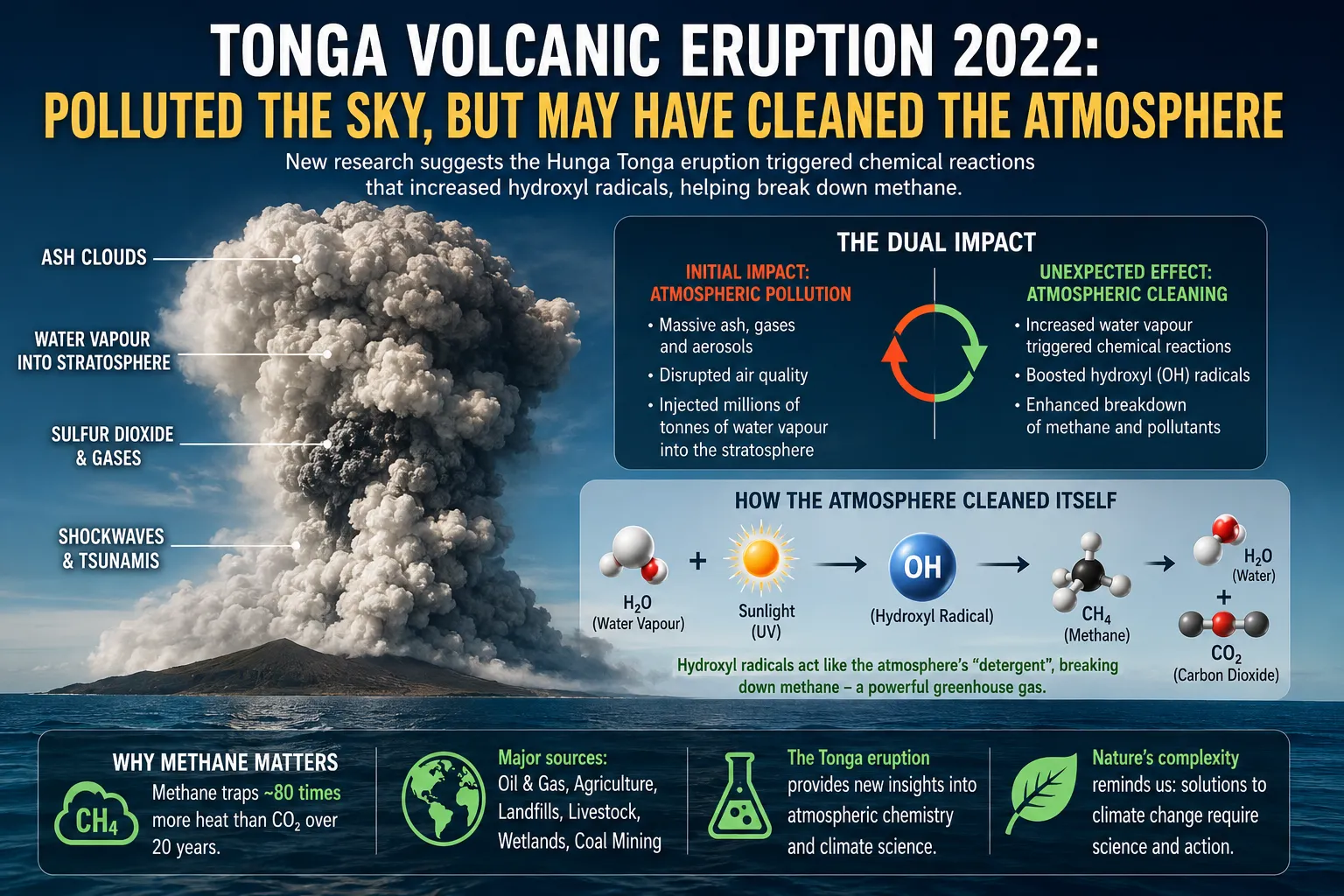
The massive underwater volcanic eruption near Tonga in 2022 remains one of the most extraordinary natural disasters of the modern scientific era. The eruption of the Hunga Tonga–Hunga Ha’apai volcano shocked researchers worldwide because of its incredible explosive force, atmospheric impact, and unusual environmental consequences. Now, new scientific studies suggest the eruption may have produced an unexpected dual effect: while it initially polluted Earth’s atmosphere with enormous quantities of ash, gases, and water vapour, it may also have contributed to temporary atmospheric cleaning processes involving methane.
The findings have generated major interest among climate scientists because methane is one of the most dangerous greenhouse gases contributing to global warming. Although carbon dioxide receives most public attention, methane is considered significantly more potent over shorter periods. Scientists estimate methane traps roughly 80 times more heat than carbon dioxide over a 20-year timeframe, making it a major driver of rising global temperatures.
The Tonga eruption’s complex interaction with atmospheric chemistry is therefore attracting global scientific attention. Researchers now believe the eruption may have triggered chemical reactions in the atmosphere that temporarily increased the production of hydroxyl radicals — molecules often described as the atmosphere’s natural cleansing agents because they help break down methane and other pollutants.
The discovery highlights how volcanic events can produce surprisingly complicated climate effects that are not always immediately understood.
The Hunga Tonga Eruption Shocked Scientists Worldwide
The eruption of the Hunga Tonga–Hunga Ha’apai volcano in January 2022 became one of the most powerful volcanic explosions recorded in decades. Located underwater near the Pacific island nation of Tonga, the volcano unleashed an enormous blast that sent shockwaves around the planet and produced atmospheric disturbances detected globally.
Satellite observations showed the eruption plume reaching extraordinary heights into Earth’s atmosphere, extending well into the stratosphere. Scientists described the event as highly unusual because underwater volcanic eruptions rarely inject such massive quantities of material so high into the atmosphere.
The explosion generated:
-
Massive ash clouds
-
Atmospheric shockwaves
-
Tsunamis
-
Volcanic lightning
-
Water vapour injections
-
Sulfur dioxide emissions
The eruption damaged communication systems in Tonga, disrupted international connectivity, and created major environmental impacts across the Pacific region.
Researchers immediately recognised that the event would become a major scientific case study for understanding atmospheric dynamics and volcanic climate effects.
Why Methane Matters So Much in Climate Change
One of the most important aspects of the new research involves methane, a greenhouse gas increasingly viewed as a critical factor in short-term climate warming.
Methane is released from several major sources, including:
-
Oil and gas production
-
Agriculture
-
Landfills
-
Wetlands
-
Livestock farming
-
Permafrost thawing
-
Coal mining
Although methane remains in the atmosphere for a shorter period than carbon dioxide, it traps heat far more effectively during its active lifetime. This makes methane reduction one of the fastest potential ways to slow near-term global warming.
Climate scientists often describe methane as responsible for roughly one-third of current global warming. Because of its powerful warming potential, even relatively small changes in atmospheric methane behaviour can significantly influence climate systems.
This is why researchers became especially interested in how the Tonga eruption may have affected atmospheric methane chemistry.
How the Volcano Polluted the Atmosphere
Immediately after the eruption, the volcano released enormous quantities of ash particles, sulfur compounds, and gases into Earth’s atmosphere.
Volcanic eruptions often influence air quality and atmospheric chemistry because they inject particles capable of altering sunlight reflection, cloud formation, and chemical reactions.
The Tonga eruption was particularly unusual because it released an unprecedented amount of water vapour into the stratosphere. Scientists estimated that the event injected millions of tonnes of water high into the atmosphere — far more than most volcanic eruptions.
Initially, researchers worried this massive atmospheric disturbance might worsen global warming by trapping additional heat and disrupting normal atmospheric balance.
The eruption also contributed to temporary air pollution effects across parts of the Pacific region and affected atmospheric circulation patterns observed by weather and climate monitoring systems.
However, as scientists continued analysing atmospheric data, they discovered something unexpected.
The Atmosphere May Have Started “Cleaning Itself”
Recent studies suggest the eruption may have triggered atmospheric chemical reactions that increased the formation of hydroxyl radicals, commonly known as OH radicals.
Hydroxyl radicals play a critically important role in atmospheric chemistry because they help remove pollutants and greenhouse gases from the air. Scientists often refer to them as the “detergent” of Earth’s atmosphere.
These radicals break down:
-
Methane
-
Carbon monoxide
-
Industrial pollutants
-
Volatile organic compounds
-
Certain greenhouse gases
The enormous injection of water vapour from the Tonga eruption appears to have influenced atmospheric reactions involving sunlight and oxygen molecules, leading to increased hydroxyl radical activity.
As a result, methane molecules in the atmosphere may have broken down more rapidly than normal during certain periods following the eruption.
This unexpected chemical response has fascinated climate researchers because it demonstrates how volcanic activity can simultaneously produce warming and cooling influences through different atmospheric pathways.
Why Scientists Are Calling the Findings Unusual
Volcanic eruptions are traditionally associated with atmospheric pollution and climate disruption. Historically, major eruptions have sometimes cooled Earth temporarily by injecting sulfur aerosols that reflect sunlight away from the planet.
However, the Tonga eruption appears to have behaved differently in several important ways.
Instead of primarily releasing large cooling sulfur aerosols, the eruption injected exceptional amounts of water vapour into the upper atmosphere. This created unusual chemical conditions not commonly observed in previous eruptions.
Scientists are particularly interested because the eruption may have indirectly enhanced methane removal processes despite initially increasing atmospheric disturbance.
This dual effect — polluting the atmosphere while also potentially accelerating methane breakdown — highlights the complexity of Earth’s climate system.
Researchers caution that the methane-cleaning effect does not cancel out broader climate risks, but it does reveal how interconnected atmospheric chemistry can be.
Understanding Hydroxyl Radicals and Atmospheric Chemistry
Hydroxyl radicals are among the most important yet least publicly understood components of Earth’s atmosphere.
These highly reactive molecules constantly interact with pollutants and greenhouse gases, helping regulate atmospheric composition. Without hydroxyl radicals, methane and many pollutants would remain in the atmosphere far longer.
The production of OH radicals depends on several factors, including:
-
Sunlight intensity
-
Water vapour levels
-
Ozone interactions
-
Atmospheric oxygen chemistry
-
Temperature conditions
Changes in any of these factors can influence how efficiently the atmosphere removes pollutants.
The Tonga eruption effectively acted as a giant natural atmospheric experiment by injecting extraordinary quantities of water vapour into the stratosphere.
Scientists are now using satellite data, atmospheric models, and chemical simulations to better understand how these reactions unfolded after the eruption.
The findings could improve future climate modelling and atmospheric prediction systems.
Volcanic Eruptions and Climate Are Deeply Connected
The Tonga event has once again demonstrated how volcanic eruptions can influence global climate systems in surprisingly complicated ways.
Throughout Earth’s history, major volcanic eruptions have affected climate through:
-
Sunlight reflection
-
Atmospheric cooling
-
Ocean circulation changes
-
Air pollution
-
Cloud formation alterations
-
Chemical atmospheric reactions
Some eruptions have temporarily lowered global temperatures for years, while others have produced shorter-term atmospheric disturbances.
The Tonga eruption appears unique because its underwater location and extraordinary water vapour release created atmospheric effects unlike many previously studied volcanic events.
Scientists believe studying the eruption could help improve understanding of:
-
Stratospheric chemistry
-
Climate feedback systems
-
Methane cycling
-
Atmospheric circulation
-
Extreme volcanic impacts
The research may also help scientists better predict how future large eruptions could interact with global warming trends.
Why Methane Reduction Remains Critically Important
Despite the interesting findings, climate experts stress that natural atmospheric reactions alone cannot solve the methane problem.
Human activity remains the primary driver of rising methane emissions worldwide. Fossil fuel extraction, agriculture, industrial processes, and waste management continue releasing large amounts of methane into the atmosphere each year.
Global climate organisations increasingly view methane reduction as one of the fastest and most effective ways to slow short-term warming.
Many countries are now investing in:
-
Methane leak detection
-
Cleaner agricultural systems
-
Landfill gas capture
-
Energy infrastructure upgrades
-
Emission monitoring technologies
The Tonga eruption findings mainly help scientists understand atmospheric processes better rather than providing a long-term climate solution.
Still, the discovery offers valuable insight into how Earth’s atmosphere naturally regulates itself under unusual conditions.
What Scientists Are Still Investigating
Researchers continue studying the long-term atmospheric consequences of the Tonga eruption because many questions remain unanswered.
Scientists are still analysing:
-
The exact scale of methane reduction
-
How long the hydroxyl increase lasted
-
Whether warming effects outweighed cooling effects
-
The eruption’s impact on global temperature trends
-
Stratospheric water vapour behaviour
-
Potential ozone interactions
The event is expected to remain a major research focus for years because of the unprecedented amount of atmospheric data collected during and after the eruption.
The findings may ultimately reshape parts of atmospheric science related to volcanic chemistry and climate modelling.
Final Thoughts
The Hunga Tonga volcanic eruption has become one of the most scientifically significant natural events in recent years because of its extraordinary impact on Earth’s atmosphere.
While the eruption initially polluted the sky with ash, gases, and massive atmospheric disruption, new studies suggest it may also have triggered natural chemical processes that temporarily helped remove methane — one of the world’s most dangerous greenhouse gases.
The discovery highlights the remarkable complexity of Earth’s climate system, where natural events can produce both harmful and unexpectedly beneficial effects simultaneously.
More importantly, the research reinforces how deeply interconnected atmospheric chemistry, greenhouse gases, and climate processes truly are. As scientists continue studying the Tonga eruption, the event may provide valuable lessons for future climate research, methane monitoring, and understanding how Earth’s atmosphere responds to extreme natural disturbances.
newstapy.com newstapy.com newstapy.com newstapy.com newstapy.com newstapy.com newstapy.com newstapy.com newstapy.com newstapy.com newstapy.com newstapy.com newstapy.com newstapy.com newstapy.com newstapy.com newstapy.com newstapy.com newstapy.com newstapy.com newstapy.com newstapy.com newstapy.com newstapy.com newstapy.com newstapy.com newstapy.com newstapy.com newstapy.com newstapy.com newstapy.com newstapy.com newstapy.com newstapy.com newstapy.com newstapy.com newstapy.com newstapy.com newstapy.com newstapy.com newstapy.com newstapy.com newstapy.com newstapy.com newstapy.com newstapy.com newstapy.com newstapy.com newstapy.com newstapy.com newstapy.com newstapy.com newstapy.com newstapy.com newstapy.com newstapy.com newstapy.com newstapy.com newstapy.com newstapy.com newstapy.com newstapy.com newstapy.com newstapy.com newstapy.com newstapy.com newstapy.com newstapy.com newstapy.com newstapy.com newstapy.com newstapy.com newstapy.com newstapy.com newstapy.com newstapy.com newstapy.com newstapy.com newstapy.com newstapy.com newstapy.com newstapy.com newstapy.com newstapy.com newstapy.com newstapy.com newstapy.com newstapy.com newstapy.com newstapy.com newstapy.com newstapy.com newstapy.com newstapy.com newstapy.com newstapy.com newstapy.com newstapy.com newstapy.com newstapy.com newstapy.com newstapy.com newstapy.com newstapy.com newstapy.com newstapy.com newstapy.com newstapy.com newstapy.com newstapy.com newstapy.com newstapy.com newstapy.com newstapy.com newstapy.com newstapy.com newstapy.com newstapy.com newstapy.com newstapy.com newstapy.com newstapy.com newstapy.com newstapy.com newstapy.com newstapy.com newstapy.com newstapy.com newstapy.com newstapy.com newstapy.com newstapy.com newstapy.com newstapy.com newstapy.com newstapy.com newstapy.com newstapy.com newstapy.com newstapy.com newstapy.com newstapy.com newstapy.com newstapy.com newstapy.com newstapy.com newstapy.com newstapy.com newstapy.com newstapy.com newstapy.com newstapy.com newstapy.com newstapy.com newstapy.com newstapy.com newstapy.com newstapy.com newstapy.com newstapy.com newstapy.com newstapy.com newstapy.com newstapy.com newstapy.com newstapy.com newstapy.com